The RPG that livesin your taskbar.
A whole RPG in 480 by 132 pixels.
A pixel-art bar floats over your desktop. Inside it, the heroes fight on their own while you work, study or browse. You never click attack: you gear up, build the party, decide where to farm and spend talents. The rest is up to them, and the legendary loot that drops can go straight to the Steam Community Market.
See on Steam (opens in a new tab) See the screens
Coming soon on Steam, for Windows. The store page already takes wishlists.
- 4 heroes
- 12 abilities
- 12 species
- 5 bosses
- 150 stages
- 54 item bases
- 10 pets
- 30 achievements
A complete RPG,the size of a window.
Taskforge does not run full screen. It lives on your desktop, in a frameless bar you drag wherever you want.
-
Lives on your desktop
A floating 480 × 132 pixel bar, frameless, draggable, with its position remembered per monitor. Scales of 0.5×, 1× and 2×, switched on the bar itself, always in crisp pixel art. “Always on top” is your choice, never imposed.
-
Fights on its own
Combat is automatic: the heroes march, attack, fall and come back without a single click. You glance between one task and the next and come back when the loot calls.
-
You run the strategy
All the management lives in a separate window, dense and dark: gear up, build the party, forge, spend talents, hatch pets, choose where to farm and take rare loot to the market. The depth of a loot ARPG, without demanding your whole screen.
Four decisions.Only four.
Everything in the game exists to enrich one of these decisions. If it does not, it stays out. That is what keeps Taskforge deep without turning into a second job.
-
1
Gear up
Which item goes on which hero. Every item card shows, attribute by attribute, what that hero gains and loses with the swap.
-
2
Build the party
Which heroes fight, and in what order. Building has a price: a fallen hero neither enters nor leaves, and every swap locks both heroes involved for a minute.
-
3
Where to farm
Push the frontier or pin a stage and farm on purpose. The Portal keeps both modes one click away, and the farm pin also sits on the bar itself.
-
4
Spend talents
Every level grants a point. Three branches per hero, each with an ability the points shape, and a keystone at the end of the branch.
Four heroes,four ways to win.
All available from the start. The party begins with one slot and earns the second and third by defeating the bosses of acts I and II. With four heroes and three slots, building the team is a real choice.
-
Guardian, Tank · melee
Closed helm, sword and shield. The only melee fighter in the cast, he holds the front whenever he is on the field. He is also the only one with three armor-bearing pieces, which is why only he reaches 85% damage reduction; the other three stop at 50%.
Sword · Shield
Abilities Iron Fury · High Guard · Containment
Keystones Retribution · Bulwark · Stubbornness -
Ranger, Physical damage · ranged
Pointed hood and fast arrows. He shoots from behind the front line and buys crit and attack speed where the others buy toughness: the arrow stream that never stops, and the most fragile hero in the cast.
Bow · Quiver
Abilities Coup de Grâce · Smoke · Cold Blood
Keystones Flurry · Evasion · Sure Shot -
Arcanist, Area damage · ranged
An elder leaning on his staff, wide hat. The game runs on “one hit, one target”, and the Arcanist is the exception: every orb hits two enemies for full damage.
Staff · Grimoire
Abilities Spark · Aegis · Frost
Keystones Conflagration · Arcane Barrier · Elemental Greed -
Cleric, Support · healing
While he is alive on the field, the whole party heals every second. He trades speed for loot: an XP helmet, item-drop gloves and reliquary. A party with a Cleric finds close to 50% more items per hour.
Scepter · Reliquary
Abilities Blessing · Litany · Fervor
Keystones Militant Faith · Swift Resurrection · Anointing
Levels per hero, up to 100. The experience of every kill is split among the living active heroes; benched heroes get a share on the side and never fall more than a few levels behind. There are 99 talent points, and the tree closes exactly at level 100.
Automatic,not shallow.
Nobody clicks an ability, but every combat rule gives weight back to your management decisions.
-
1
The melee fighter tanks
Melee enemies only hit the front, and the front belongs to the Guardian whenever he is on the field. Ranged enemies spread their shots: the back row takes hits too. A party without a tank is allowed, at your own risk.
-
2
Dodge per hit
Every incoming hit can be fully negated. Dodge is the only defensive axis with variance: it changes the shape of the damage, not just the average.
-
3
Armor that always counts
Linear mitigation: every armor point reduces the same damage anywhere in the game. The same piece means the same thing from act I to Infernal, with no plateau.
-
4
Healing has a price
There is no free regeneration. Healing costs life steal on weapons, a living Cleric taking up a slot, or talent points. Clearing a stage restores full health: HP is a per-stage resource.
-
5
Death costs, the game goes on
A fallen hero sits out for a minute and comes back on his own while the living hold the wave. If the whole party falls, it stays down for that same minute and retreats one stage.
-
6
Stages of about five minutes
Every attempt resolves: the party clears or falls, in about five minutes on average and never more than ten. Bosses are power gates: you fail, farm, come back stronger and cross.
Five acts, three difficulties,one hundred and fifty stages.
Each act is a scene with its own palette: you know where you are by the color, before reading any name. At the end of each act, a boss waits on stage 10.
- Act I Oldstone Fields
- Gold and amber over dry green
- Act boss King Ossorio · Throne Strike
- Act II Whisperwood
- Dark green and grayish blue
- Act boss Old Ramalho · Roots
- Act III Drowned Marsh
- Sickly ochre green and brown
- Act boss Gapemaw · Lunge
- Act IV Ironbottom Mines
- Rock gray with an amber glow
- Act boss Rockgnaw · Grind
- Act V Ember Citadel
- Black and red
- Act boss Lord of Embers · Breath
Three difficulties: Normal is the campaign, Hard is the build test and Infernal is the end of the world. Attribute gems unlock on Hard, and filling a hero's eighteen sockets is a post-campaign goal.
The Portal has two modes with meaning. On the frontier, you progress: advance when you clear, retreat when you fall. Farming, you pin a stage and repeat it on purpose. A conquered stage is yours forever, and a locked stage can be peeked at so you know what it pays.
The boss alternates attack and rest and, on crossing 66% and 33% of his own health, unleashes his signature, with its name highlighted on the bar. When he enters, the party revives at full health, but only heals by half while he is on the field. Damage per second wins.
Twelve species to take down
Each one recognizable by silhouette alone, at any scale.
-
Skeleton Warrior
acts I–V
-
Grey Wolf
acts I–II
-
Brute Orc
acts I, II and V
-
Crooked Scarecrow
act I
-
Slinger Goblin
acts II–III
-
Mire Serpent
acts II–III
-
Weaver Spider
acts III–IV
-
Gargoyle
acts III–IV
-
Stone Golem
acts IV–V
-
Watching Eye
acts IV–V
-
Iron Sentinel
acts IV–V
-
Ember Hound
act V
Elites are the climax of every regular stage: the same creature, 1.5× bigger and with a colored outline, paying a guaranteed item. Four species cast their own ability as elites: the Mire Serpent's Venom, the Weaver Spider's Web, the Watching Eye's Focus and the Iron Sentinel's Volley.
The item tellsthe truth.
No hidden power, no lying gear score: the item carries final values, and what the card says is exactly what enters the hero's sheet.
Nine slots and 54 named bases. Every slot guarantees a primary attribute: the weapon gives damage, the chest gives armor, the boots give life. Accessories are pure luck, affixes only. And every piece has its own name and icon: you hunt the mythic Shortsword, not “weapon no. 3”.
Eleven attributes feed DPS, survival and findings. Every affix rolls a value on a 51-step grid within its own range, and the card shows the real delta against what is equipped. An affix is not a sentence: you can reroll the value of one, or redraw them all.
 Common
- 0 affixes
- no socket
 Uncommon
- 1 affixes
- no socket
 Rare
- 2 affixes
- no socket
 Epic
- 3 affixes
- up to 1 socket
 Legendary
- 4 affixes
- up to 2 sockets · market-eligible
 Mythic
- 5 affixes
- up to 2 sockets · market-eligible
The Workshop: five services and the gem forge
-
Upgrade
Item + gold, up to +20, with the first level guaranteed and the rate of every next level shown before the click. On failure you lose only the gold: the item never breaks, never regresses.
-
Enchant
Rerolls the value of an affix of your choice; the type does not change. A declared bet: the screen shows where the roll landed in the range, and every enchant on the same piece costs 10% more than the last.
-
Transmute
Redraws all affixes, type and value, paid in gold and shards. Primary, rarity and level stay. It turns “the right piece dropped with the wrong affixes” from a sentence into a price.
-
Disposal
An unwanted item has two exits: dismantle for shards or sell for gold, in bulk, with filters and both totals in view. Junk becomes gold, a good find becomes shards.
-
Targeted craft
Pick the piece, the rarity and the level, paid in shards. The affixes still roll: crafting guarantees the base, the hunt goes on.
-
Gem forge
Eleven gems, one per attribute. Craft the gem your build needs, expensive on purpose, or combine seven equal gems to go up a tier. Socketing is a commitment: the gem stays in the piece or breaks.
Ten pets, hatchedwith patience.
A pet follows the party, and it is not a fourth hero: it does not tank, die or gain XP. Seven of the ten change the shape of your farm; only three add combat power.
-
Harpy
more gold per kill
-
Basilisk
higher gem chance
-
Forge Wyrmling
cheaper upgrades
-
Hornet
more hours of offline progress
-
Spectral Owl
more XP per kill
-
Bone Hyena
higher egg chance
-
Griffin
boss returns sooner
-
Black Boar
party damage per hit
-
Obsidian Scorpion
party armor
-
Phoenix
party passive healing
Eggs drop in combat, on the same rarity ladder as items. In the Nest, one egg hatches at a time, with a queue of four behind it: from 20 minutes to 24 hours depending on rarity, and the clock runs with the game closed. Whoever picks what hatches overnight picks what they see in the morning.
Closed the game? The heroes keep earning XP and gold, and the egg keeps hatching. But offline never advances a stage, drops an item or an egg, or kills anyone: the decisions and the rewards of being present stay yours. Idle time does not buy gear.
Your drops are worthsomething on the Steam Market.
Legendary and mythic equipment and legendary and mythic pets leave the game for your Steam inventory, where they sell, buy and trade on the Community Market. Before leaving, every piece is checked by the game server: only loot that dropped in combat enters the market.
-
1
Born online, it earns the seal
A legendary or mythic piece that drops with the game online is born eligible, with a discreet seal on its card. The server replays your run and checks the drop before accepting the export.
-
2
Exporting costs, and has a cap
Exporting charges shards, the yield of three dismantles of that rarity, and every account has a weekly cap. Gold and Dew never pay for exports: money never turns into items.
-
3
Comes back whole
A piece bought on the market returns to the game with base, rarity, level, affixes, upgrade and sockets preserved, and it comes in even with storage full.
-
4
Paid currency does not buy power
Dew is the only currency bought with money, and it also trickles in on every first boss kill. It buys convenience: VIP and speeding up an egg you already have. It never buys an egg, a pet, rarity or an export.
VIP: comfort by subscription, never power
Thirty days for 1,000 Dew, with no automatic billing. Four more stash tabs, a Nest queue of sixteen, automatic recycling by rarity and 100 Dew back on every purchase. No bonus to drops, rarity, gold, XP or damage: the free tier is enough for the whole campaign, up to the end of Infernal.
The market does not change the game for those who do not use it. Loot drops the same, crafting is the same and nothing in combat depends on buying or selling.
The managementwindow.
Dense, dark and honest: numbers the engine does not expose show up as “—”, and a system that does not exist yet gets no button. The interface never pretends.
-
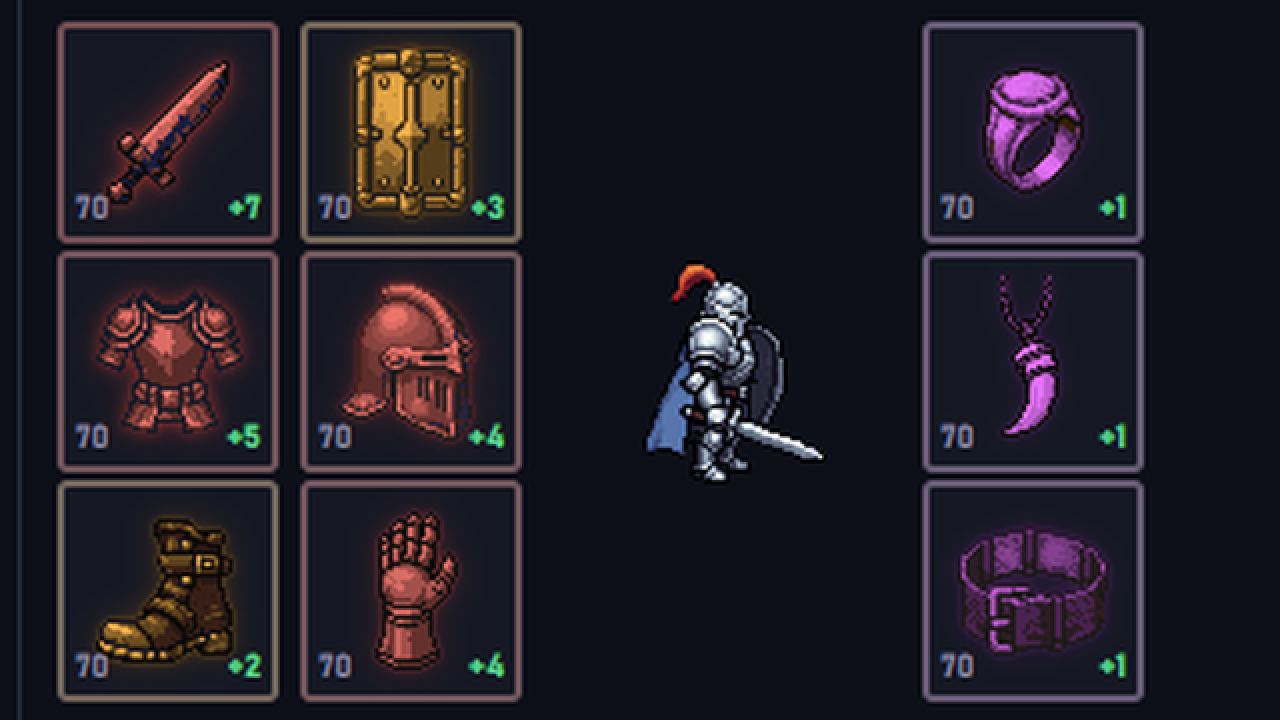
Inventory: the Guardian's paper doll with all nine pieces equipped -
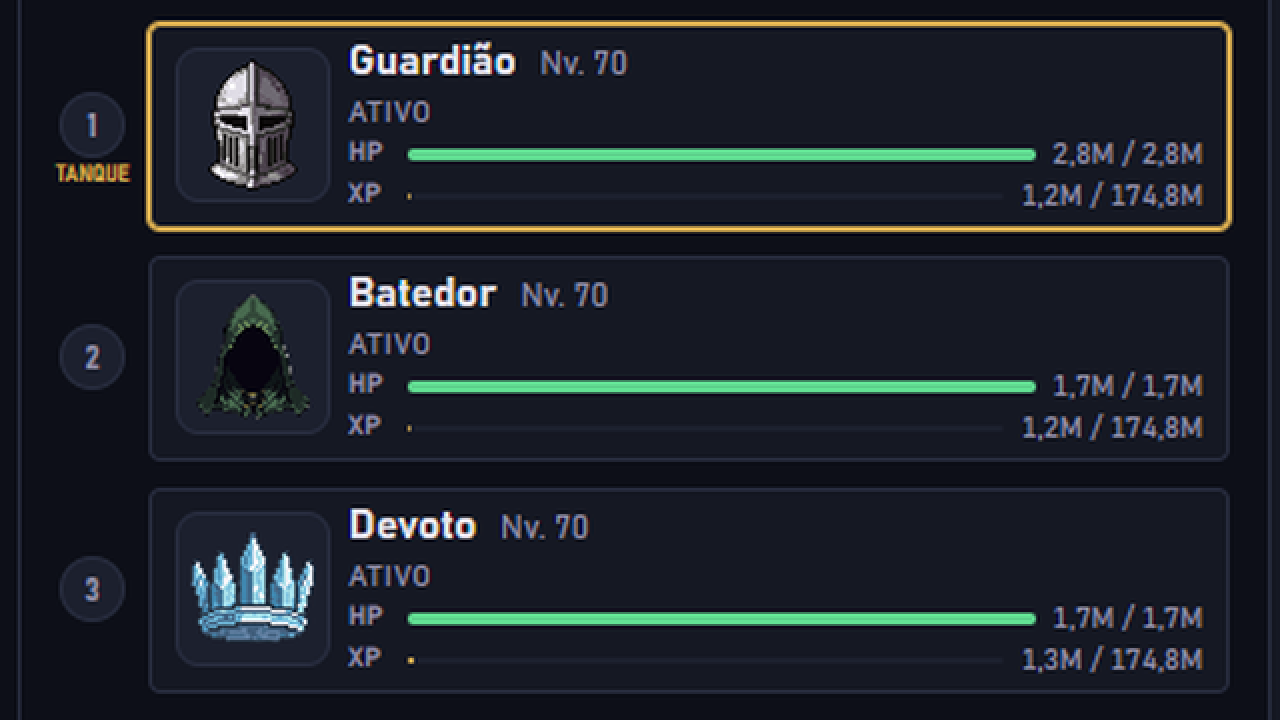
Hero: the three numbered fighting slots, with the Guardian marked as tank in the first -
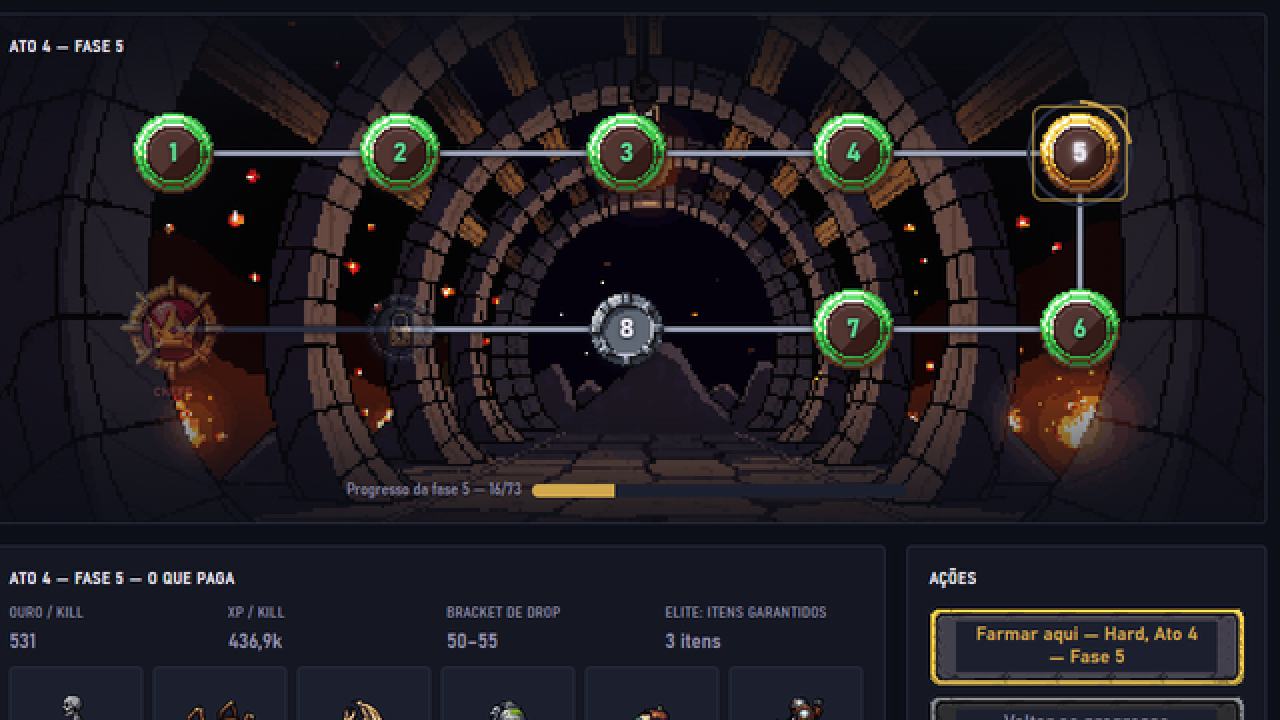
Portal: the ten-stage path winding through the act's scenery, with the boss at the end
Where the gamestands today.
Taskforge already has its Steam page, for Windows, and is coming soon. Add it to your wishlist to be notified at launch. Questions, press and partnerships: get in touch.